What Is the MCP Server?
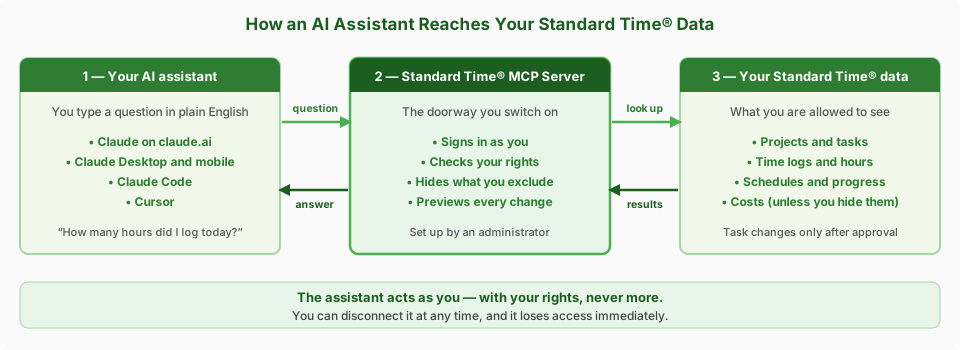
MCP (Model Context Protocol; see the glossary) is an open standard that lets an AI assistant connect to outside tools and data. The MCP Server in Standard Time® is a secure doorway built on that standard. Switch it on, connect Claude to it, and you can talk to your own shop-floor data:
- It acts as you. Claude signs in with your Standard Time® login and gets the same rights you have — no more.
- It sees only what you may see. Projects you are not assigned to, or costs you may not view, stay hidden.
- It asks before changing anything. Every change is shown as a preview first, and nothing is written until you approve it.
- You stay in control. You can hide cost fields and user names, make a connection read-only, and disconnect at any moment.
What You Can Ask It to Do
Look things up
Ask the way you would ask a coworker. Claude finds the records, runs the numbers, and tells you the answer. Standard Time® does the arithmetic, so totals are not guessed.
- “How many hours did I log today? Break that down by project.”
- “Which tasks on project 10200 are due this week?”
- “Which employees logged time on the pump housing order this month?”
- “Compare planned hours with hours worked on each task in this project.”
Turn answers into charts and summaries
Claude can take what it found and draw a chart, build a table, or write a short status summary for a meeting — whatever you ask for in the chat.
Change your tasks — with your approval
Claude can propose edits to project tasks and show you exactly what would change before anything is saved. It can work on:
- Progress and status — percent complete and completed
- Schedule — dates, planned hours, and the order of tasks
- Links between tasks — predecessors and successors
- Details — billable flag, category, subproject, assignments, and description
- New work — create new tasks and projects, or copy a project or subproject, when you allow it (up to 25 new tasks per proposal)
See Change Tasks Safely for a full walk-through.
What it does not do
- It does not change time logs, expenses, or invoices, and it cannot edit an existing project's own settings.
- It never deletes or merges records.
- It does not export files or send e-mail on its own.
Before You Start
| You need | Details |
|---|---|
| A Standard Time® cloud account | The MCP Server is part of the Standard Time® cloud service. On-premise installs are not supported. |
| The “Access to AI” right | The person who connects needs the same Access to AI right that AI Chat uses. An administrator sets rights in Users and Organization. |
| An administrator login (for sign-in) | By default, only an administrator can approve a connection when Claude asks you to sign in. If you are not an administrator, ask one to connect, or to issue you a key (see Connect Claude Code or Cursor With a Key). |
| A Claude account that can add custom connectors | Custom connectors are a Claude feature. Check Anthropic's current plan details for which plans include them. On team and enterprise plans, an organization owner may need to allow custom connectors first. |
| Your connector address | The MCP Server dialog shows the Connector URL for your account. You copy it into Claude in a moment. |
Connect Claude on claude.ai
This is the usual way to connect. It works for claude.ai in a browser, and the same connection is available in Claude Desktop and the Claude mobile app once you sign in to the same Claude account. You sign in with your own Standard Time® login — there is no key to copy and no client ID or secret to enter.
- In Standard Time®, open Tools › Integration › MCP Server and copy the Connector URL.
- In Claude, open Plugins, click Add, then choose Add custom connector.
- Enter a name, paste the address, and click Continue.
- Keep the sign-in choices as they are and click Add.
- Click Connect, sign in to Standard Time®, choose what Claude may do, and click Allow.
Step 1 — Open the MCP Server dialog and copy the address
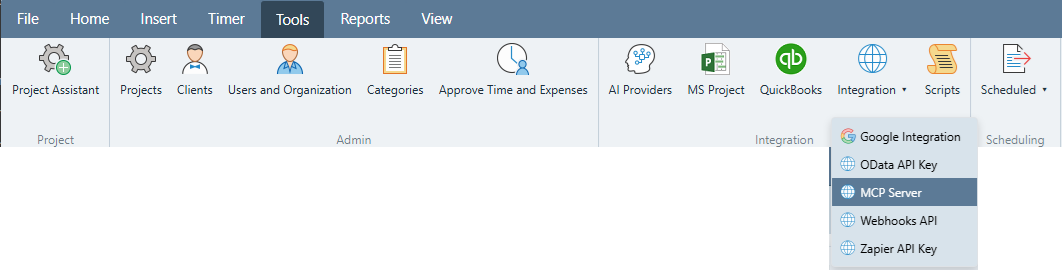
In Standard Time®, open the Tools ribbon, click the Integration dropdown, and choose MCP Server.
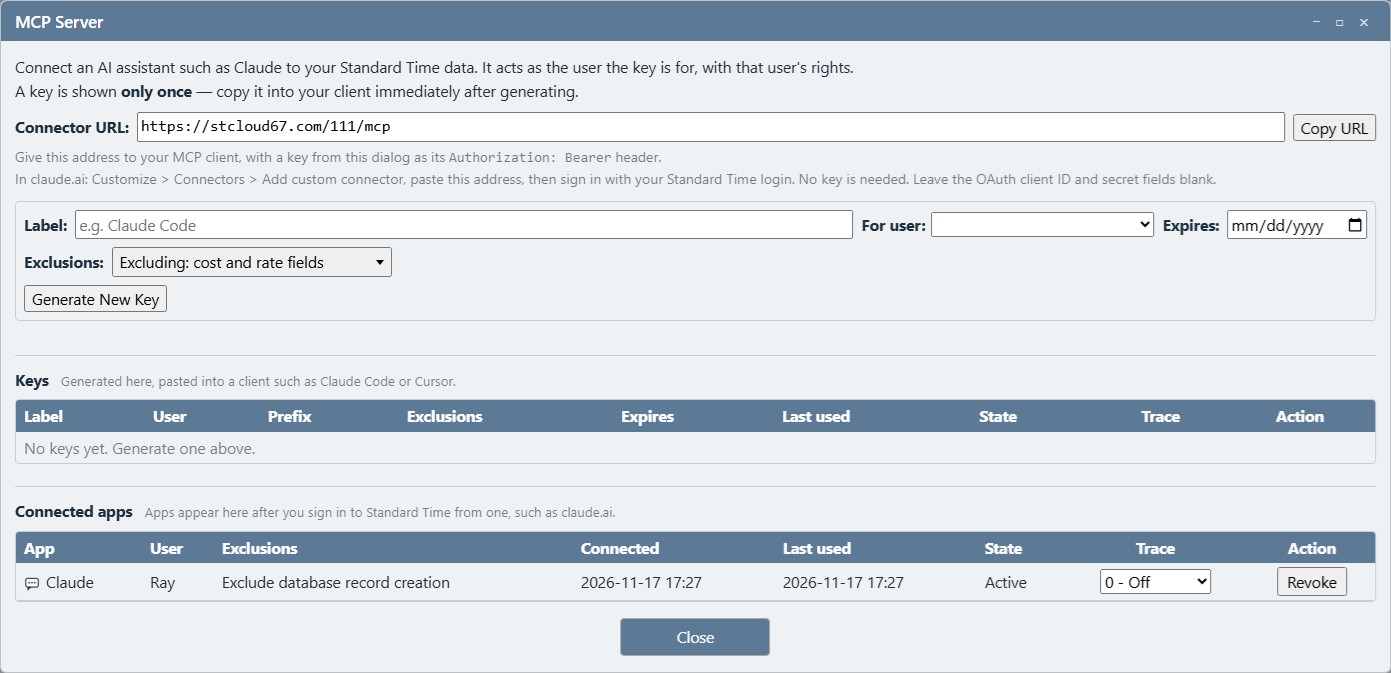
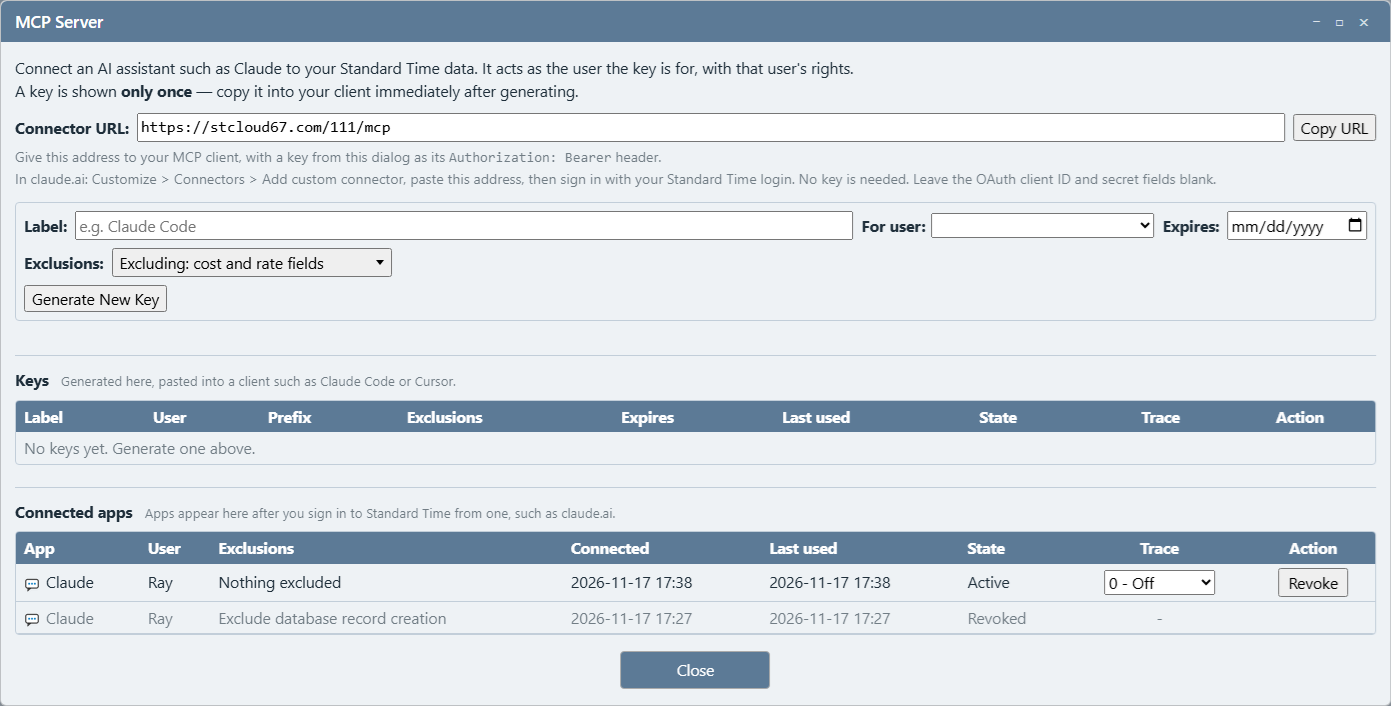
The dialog shows your Connector URL. Click Copy URL. Anything Claude connects to appears under Connected apps at the bottom of this same dialog, which is also where you disconnect it later.
Step 2 — Add a custom connector in Claude
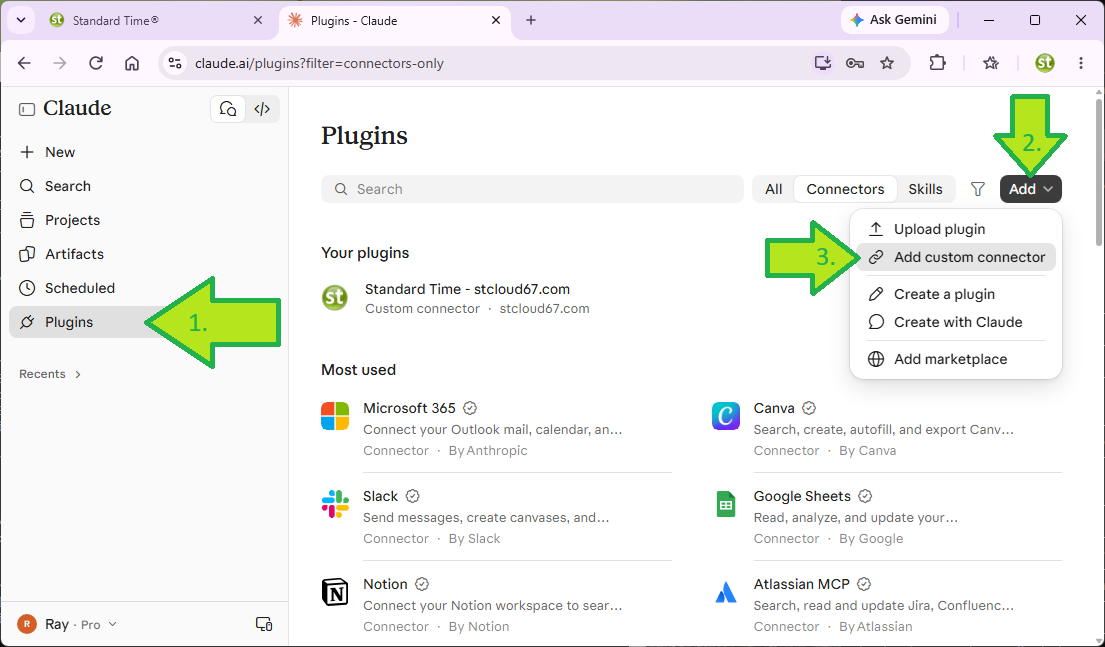
In Claude, click Plugins in the left sidebar, then Add, then Add custom connector. (Anthropic occasionally renames menus. If you do not see these labels, look for where Claude lets you add a custom connector.)
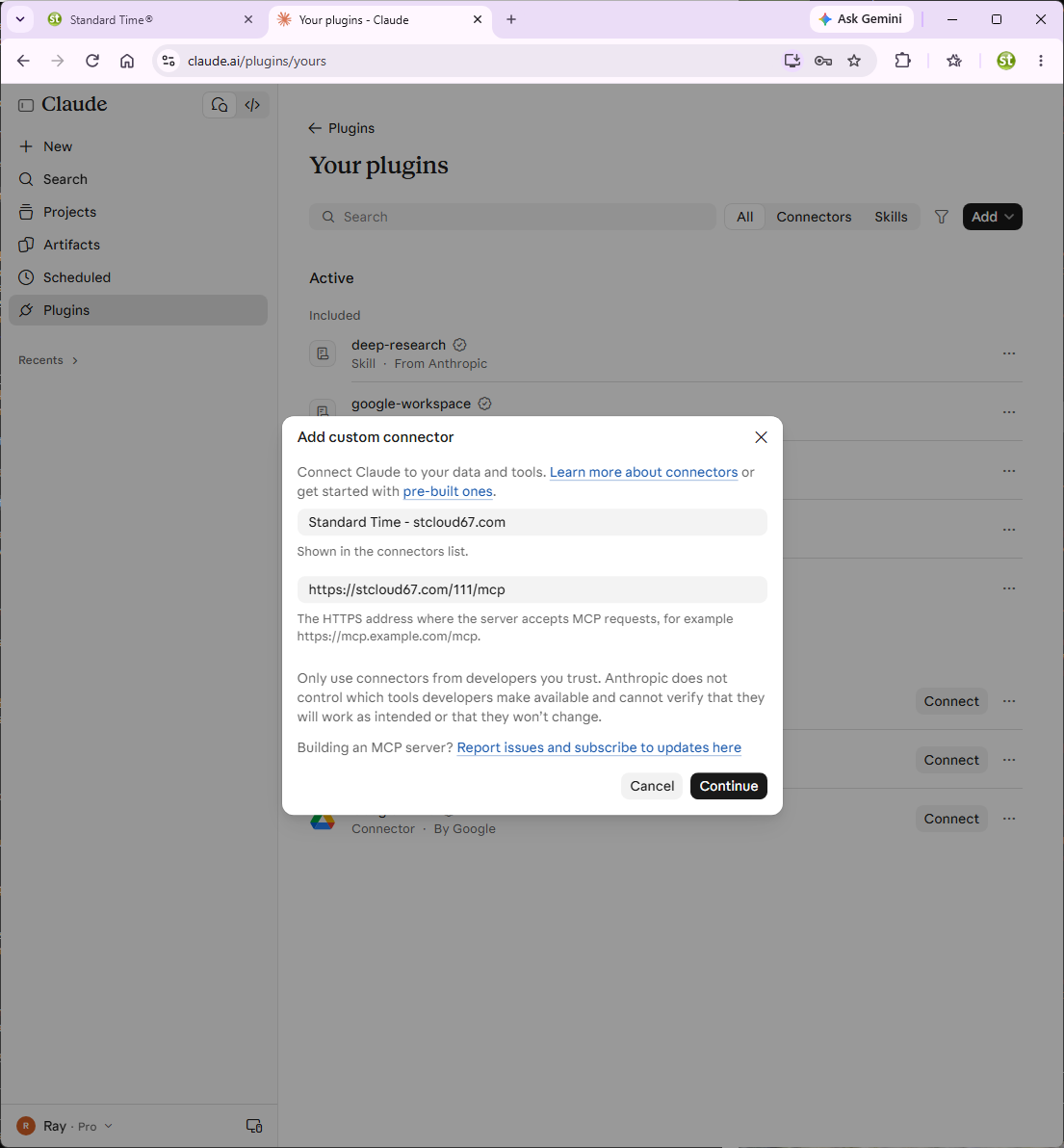
Step 3 — Name it and paste the address
Type a name you will recognize, such as Standard Time, paste the Connector URL you copied, and click Continue.
Step 4 — Keep the sign-in choices and click Add
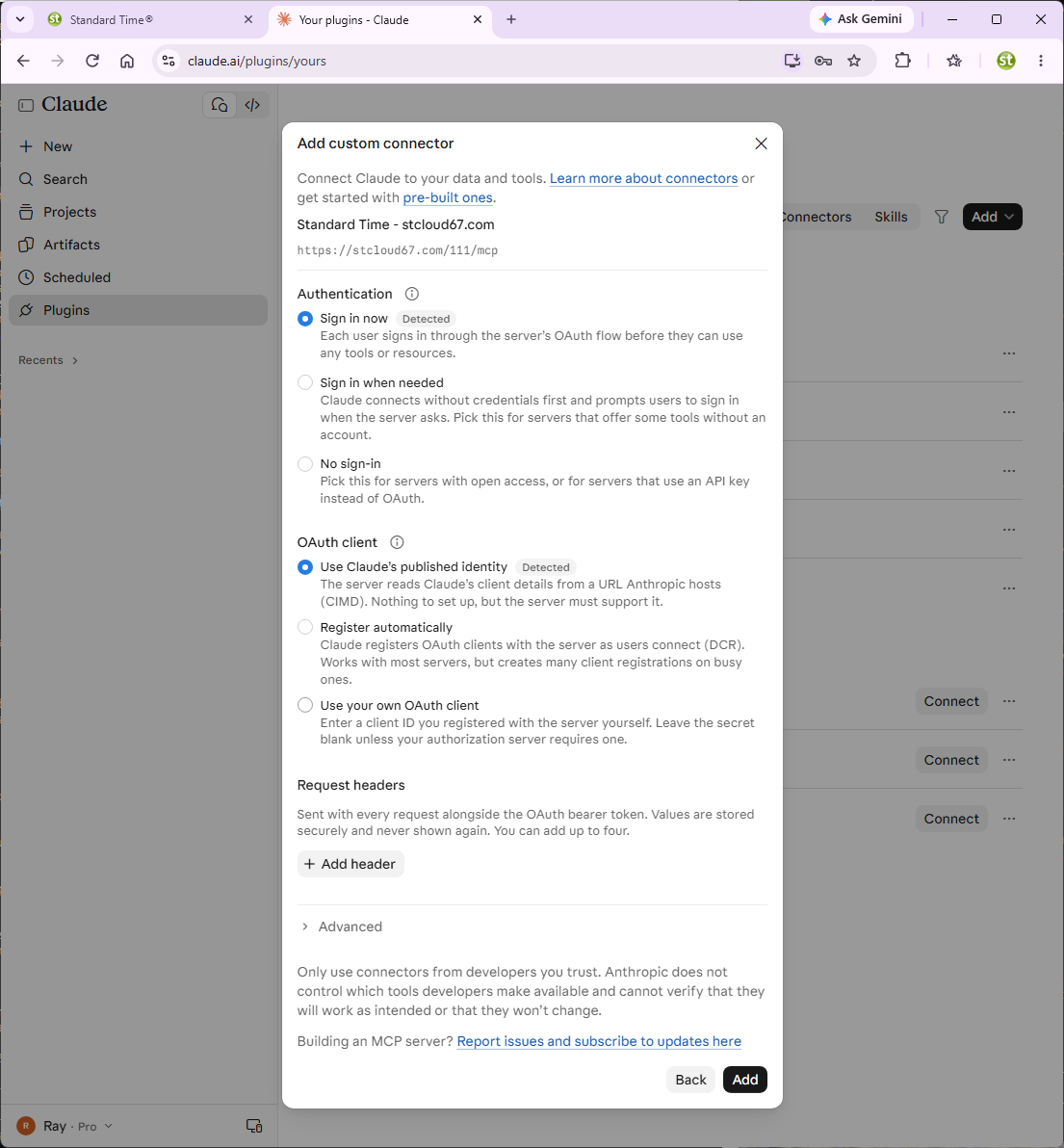
On the next screen, Claude detects the right settings and marks them Detected. Leave them alone:
- Authentication: Sign in now — each person signs in with their own Standard Time® login.
- OAuth client: Use Claude's published identity — nothing to set up, and no client ID or secret to type.
- Skip Request headers and Advanced. They are for other kinds of connectors.
Click Add.
Step 5 — Connect and sign in to Standard Time®
Click Connect on the new connector. Your browser opens a Standard Time® page titled Connect an app to Standard Time. Enter your Standard Time® username and password, choose what Claude may do, and click Allow.
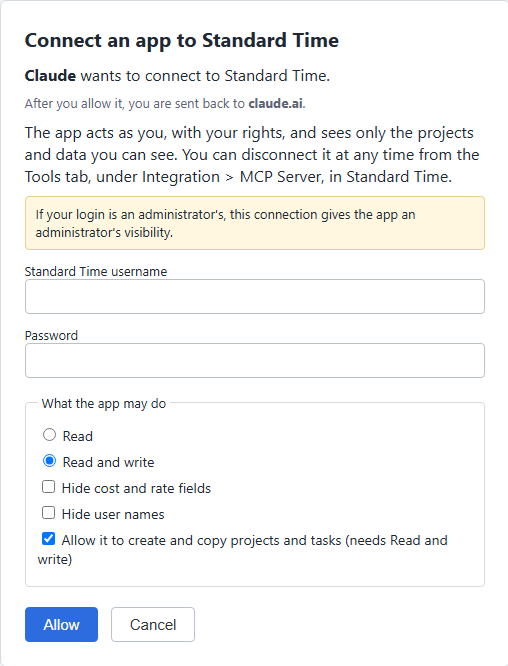
| Choice | What it does |
|---|---|
| Read | Claude can look things up but can never propose a change. |
| Read and write | Claude can look things up and propose changes to tasks. Nothing is saved until you approve it. |
| Hide cost and rate fields | Client and salary costs and rates are withheld from Claude, even if your own rights allow you to see them. A good choice unless you want Claude to answer cost questions. |
| Hide user names | Claude sees stand-ins such as “User 1” instead of real employee names. |
| Allow it to create and copy projects and tasks | Lets Claude propose brand-new tasks and projects and copies of existing ones. Needs Read and write. You still approve each proposal. |
These choices are fixed for that connection. To change them later, disconnect and connect again (see Disconnect or Revoke Access).
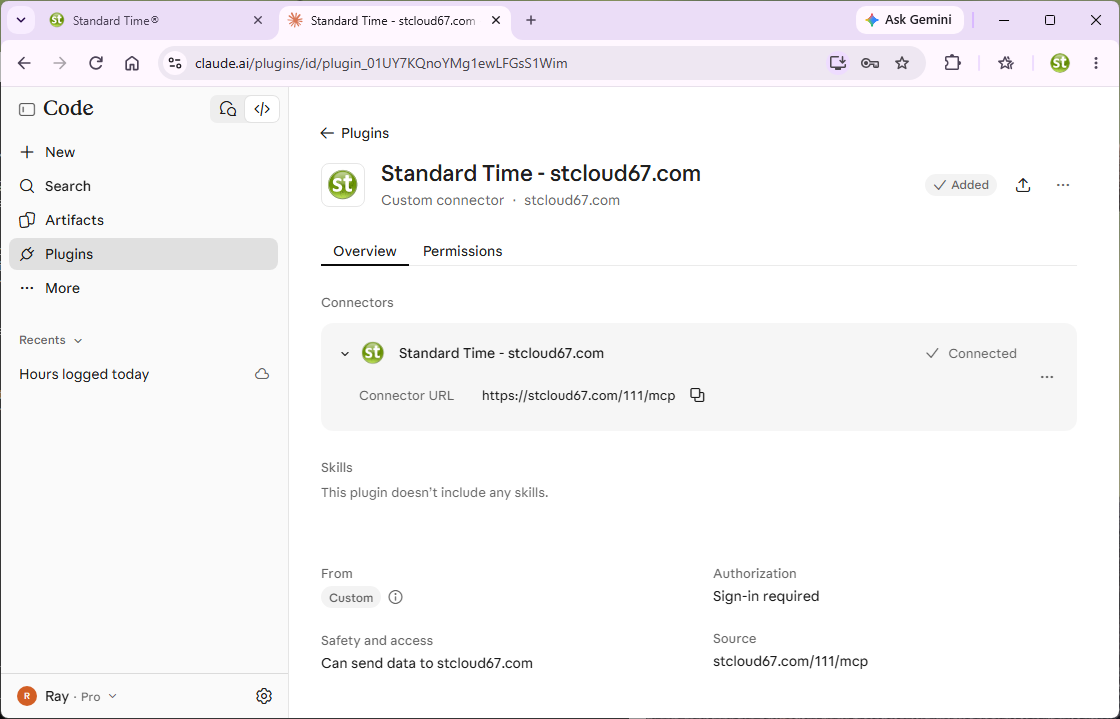
Step 6 — Confirm it says Connected
Back in Claude, the connector now shows Connected and lists its address. A new row also appears under Connected apps in the Standard Time® MCP Server dialog.
Turn It On in a Chat and Ask a Question
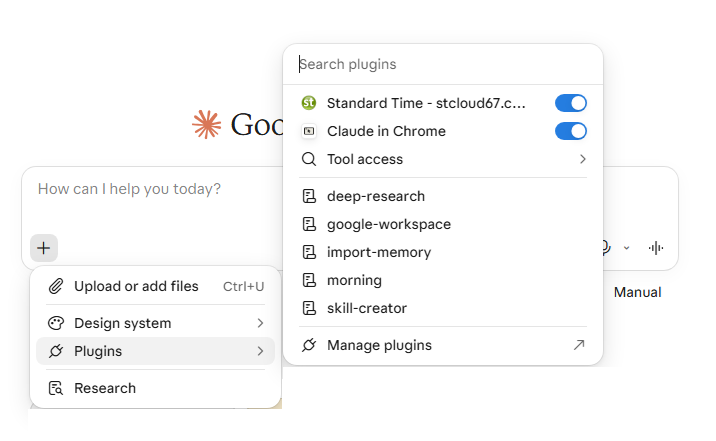
In a new Claude chat, click the + button, choose Plugins, and make sure the Standard Time switch is on. Then ask your question.
The first time Claude uses a Standard Time® tool in Manual mode, it stops and asks permission. Read-only lookups are safe to allow. Claude then answers from your live data and shows which tool it used, so you can see where the numbers came from.
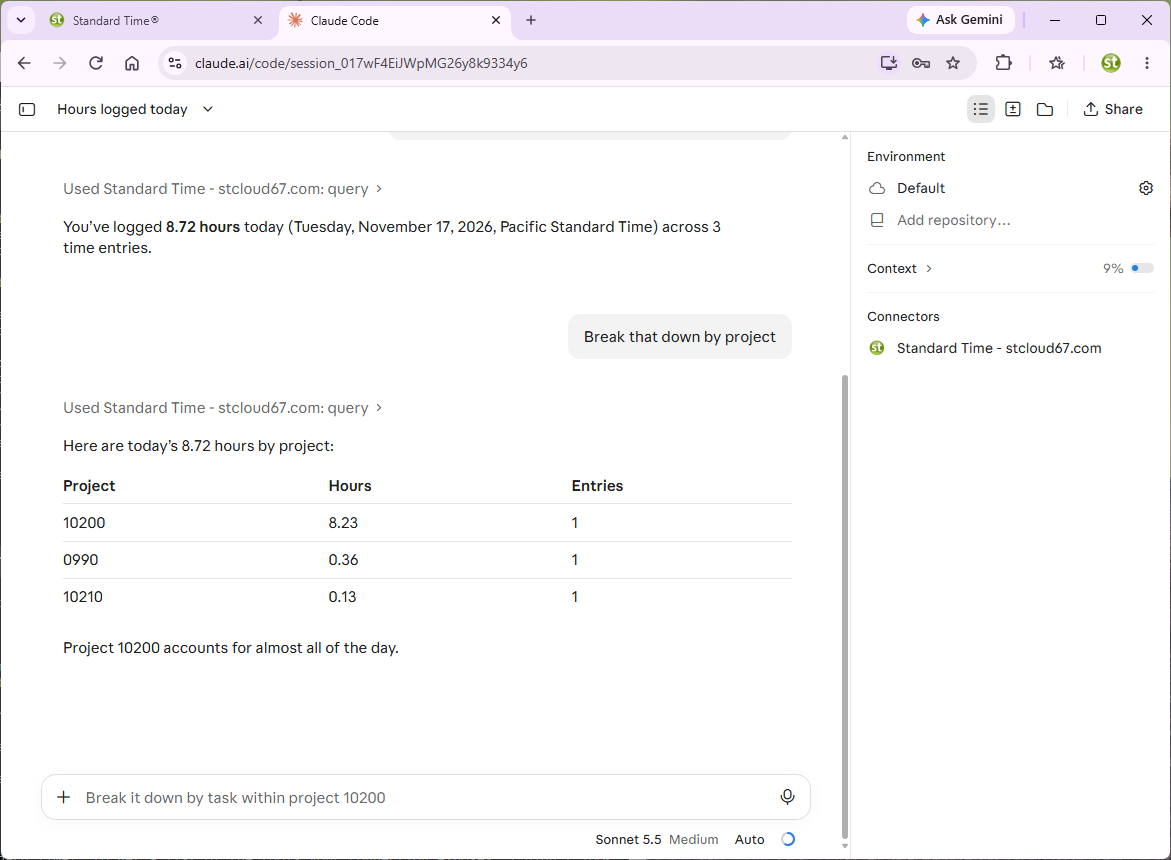
Follow-up questions work the way you would expect: “Break it down by task within project 10200,” or “Draw a bar chart of hours per day this month.”
Change Tasks Safely: Preview, Approve, Apply, Undo
Reading is harmless, but changing your schedule is not. So every change goes through the same four steps, and nothing is written until step 3.
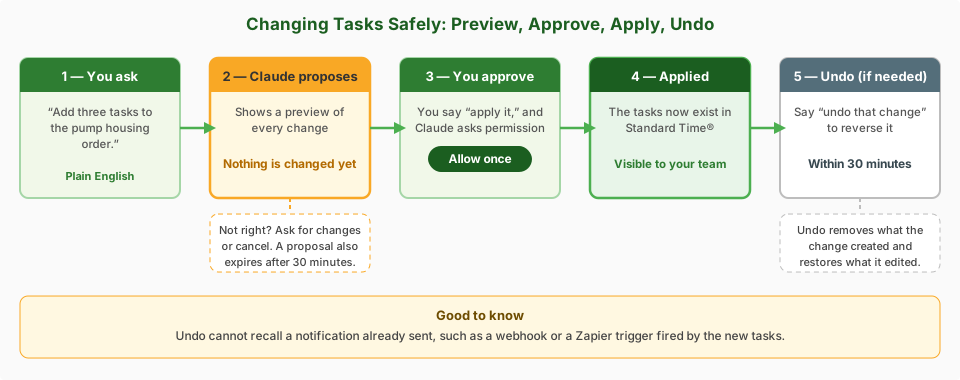
A worked example
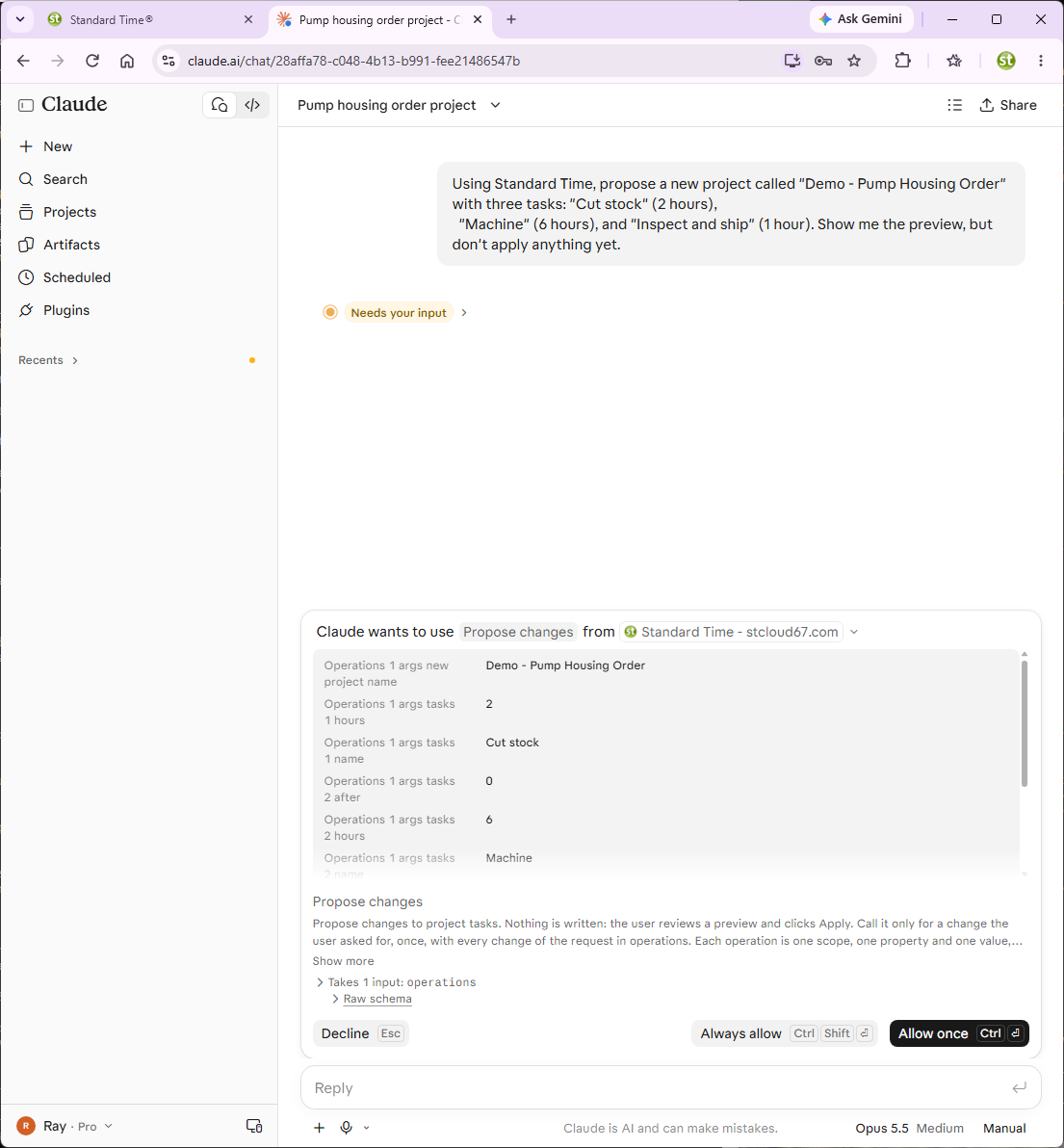
Here Claude is asked to add a small project with three tasks:
1. Claude prepares a proposal
In Manual mode, Claude first asks permission to use the Propose changes tool. A proposal writes nothing — it only checks the request and builds a preview.
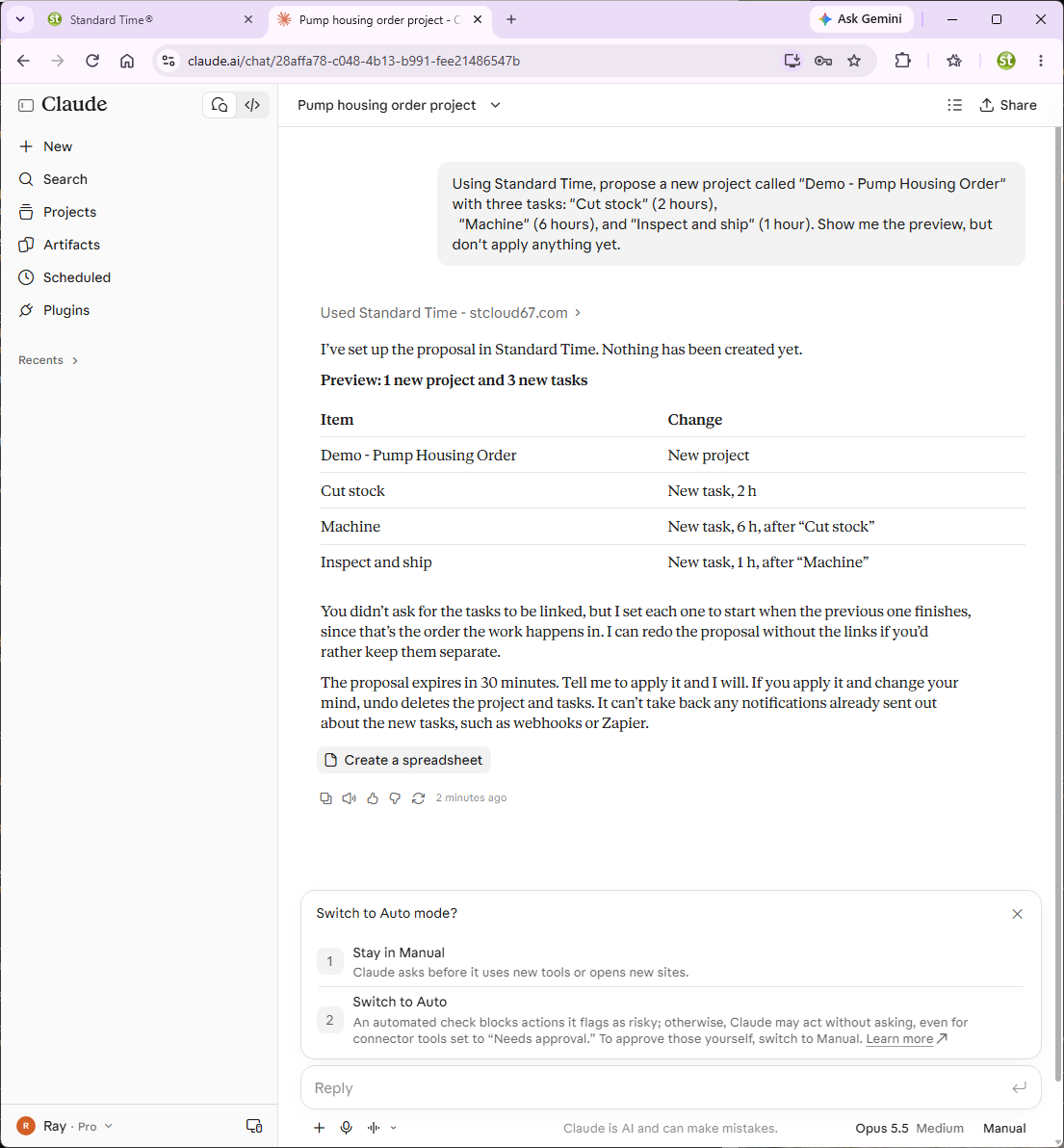
2. You read the preview
Claude shows what would change, in a table, and says plainly that nothing has been created yet. Read it carefully. In this example Claude also linked the tasks so each starts when the one before it finishes — something it was not asked to do — and said so, offering to redo the proposal without the links.
3. You approve — and Claude asks once more
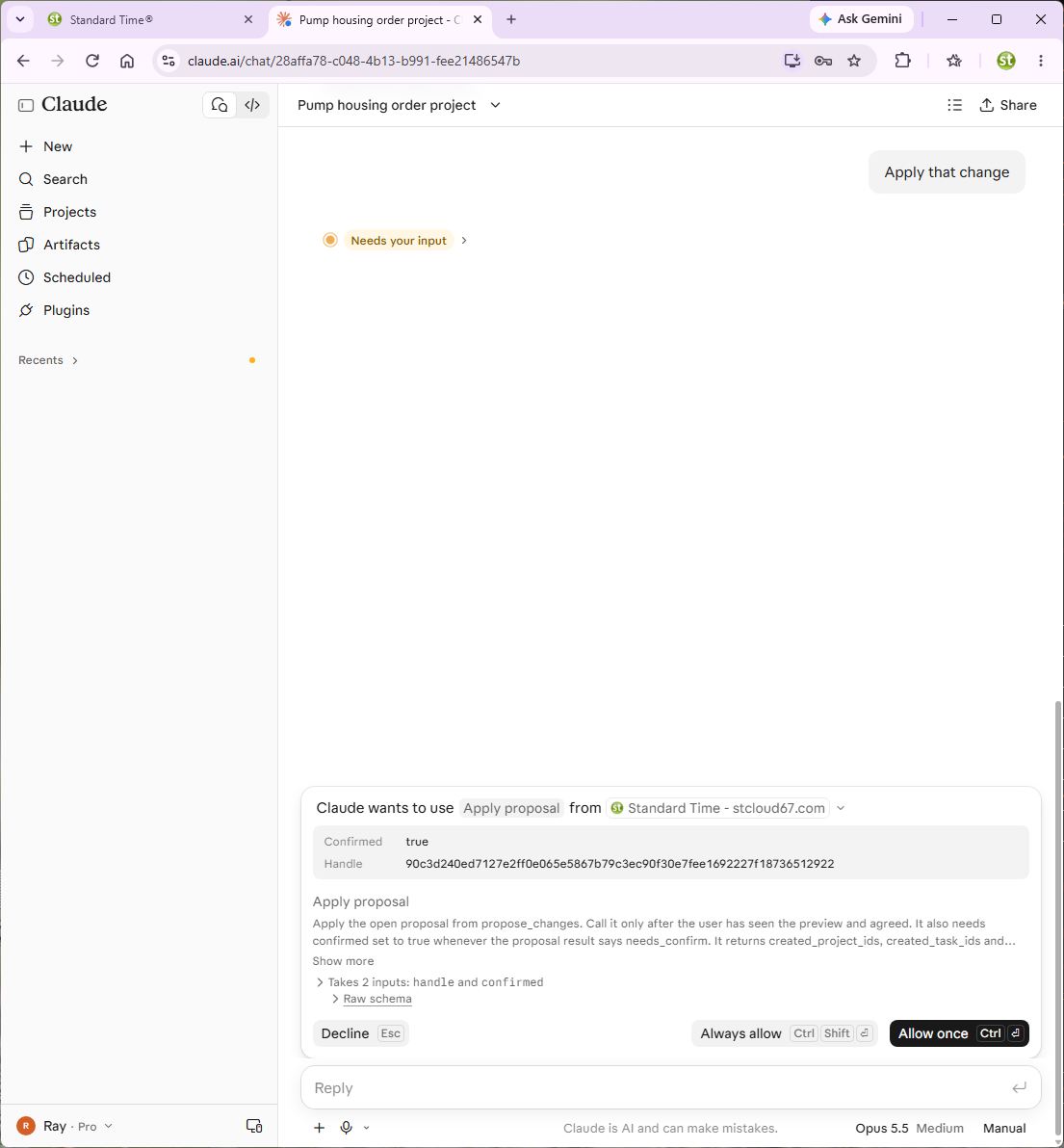
Tell Claude to apply it (“Apply that change”). In Manual mode, Claude then asks permission to use Apply proposal, the one tool that actually saves changes. Click Allow once.
4. The change is applied
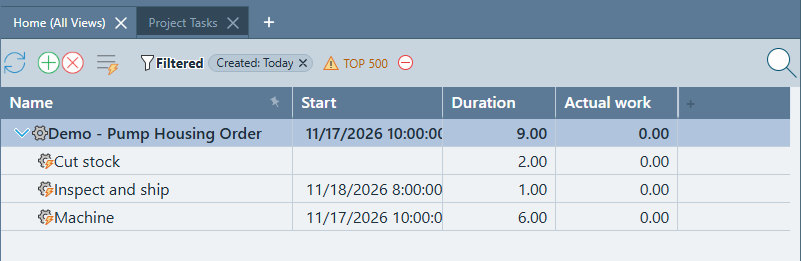
The project and its three tasks now exist in Standard Time®, and everyone with access sees them like any other records.
5. Undo, if you change your mind
Say “Undo that last change.” Undo removes anything the proposal created and restores anything it edited. It works for 30 minutes after the change was applied.
Good to know
- One proposal at a time. A new proposal replaces the one that is open.
- A proposal lasts 30 minutes. If it has expired, or you were disconnected, Claude tells you the proposal is no longer available. Ask it to propose again.
- Big previews are summarized. The preview lists up to 25 changed rows. If more would change, Claude tells you how many are not listed.
- Large schedules take rounds. A proposal can add up to 25 new tasks. For 60 tasks, Claude builds the project with the first 25, then attaches the next batches to it, asking for your approval each time.
- Your rights still apply. Adding tasks to an existing project needs the Can create new project tasks right. Starting a new project, or copying a whole project, needs an administrator who has Administer projects, clients, etc.
- Projects can opt out. A project whose AI-updates setting is turned off is skipped, and Claude tells you which rows it could not change.
- Review every preview. Claude can make mistakes. The preview is your chance to catch them.
Manual Mode, Auto Mode, and Tool Permissions
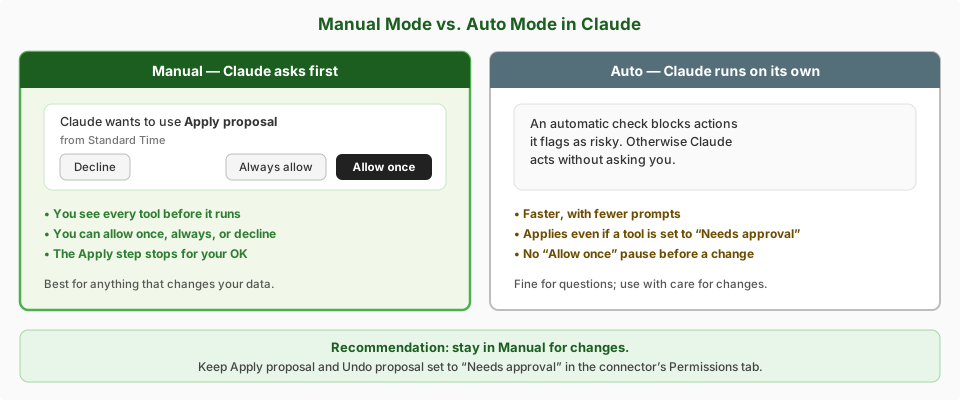
Claude has two ways of deciding when to ask before using a tool. You can see which one you are in at the bottom right of the chat box, where it says Manual or Auto.
The connector's Permissions tab
In Claude, open Plugins, click your Standard Time connector, and choose the Permissions tab. Each tool can be set to allow, needs approval, or blocked. Standard Time® offers seven tools:
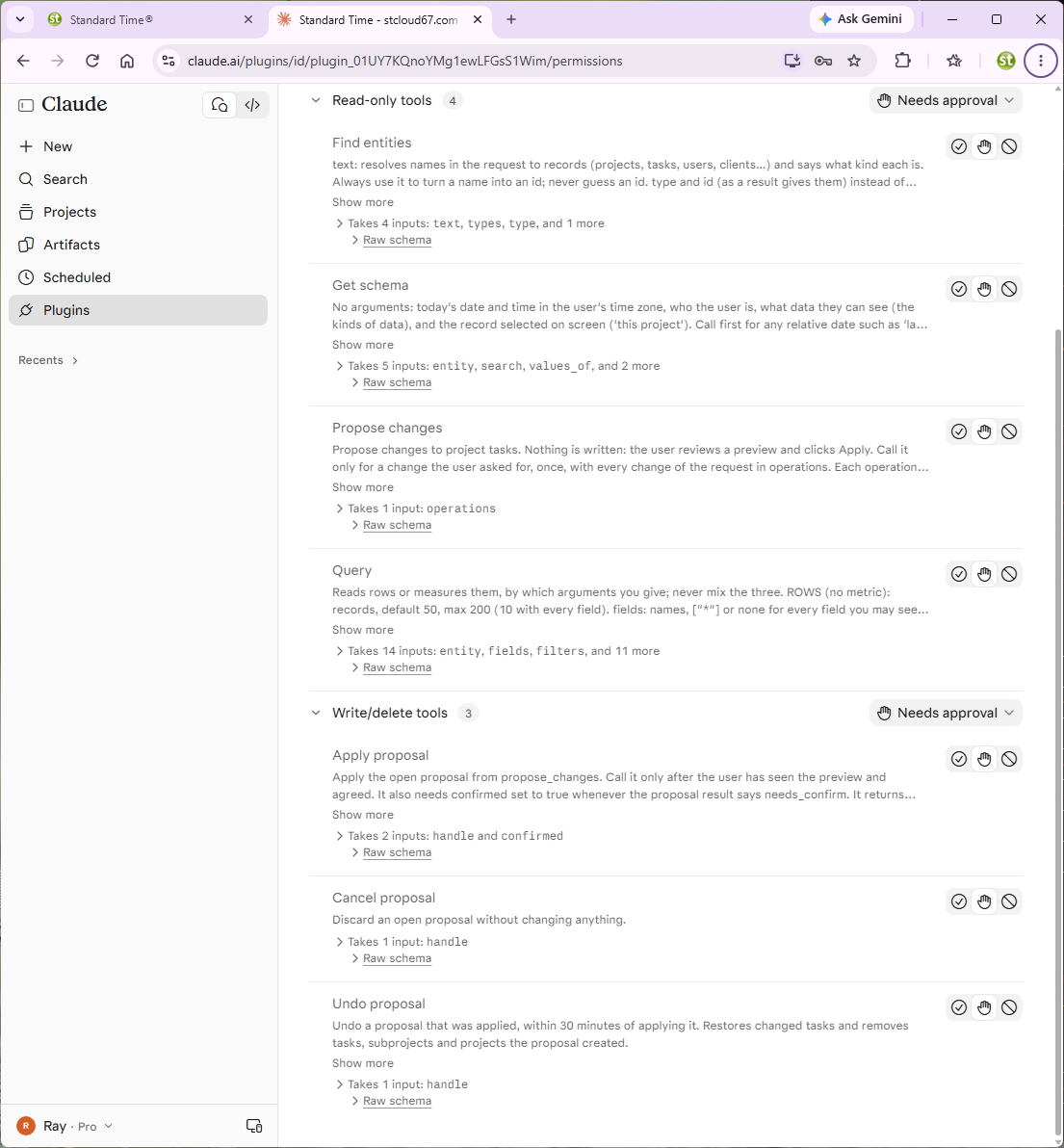
| Tool | Changes data? | What it does |
|---|---|---|
| Find entities | No | Turns a name you type, such as a project, task, employee, or client, into the right record. |
| Get schema | No | Tells Claude today's date, who you are, and which kinds of data you can see. |
| Query | No | Reads rows or totals, such as hours by project or tasks due this week. |
| Propose changes | No | Builds a preview of a change. It is listed with the read-only tools because it writes nothing. |
| Apply proposal | Yes | Saves an open proposal after you have seen the preview and agreed. |
| Cancel proposal | No | Throws away an open proposal without changing anything. |
| Undo proposal | Yes | Reverses an applied proposal within 30 minutes of applying it. |
A sensible setup: set the read-only tools to allow, so you are not prompted for every lookup, and leave Apply proposal and Undo proposal on Needs approval so every change still stops for you.
Limit What the Assistant Can See and Do
Several layers keep the assistant inside the lines. Each one can only narrow what it can reach — none of them widens it.
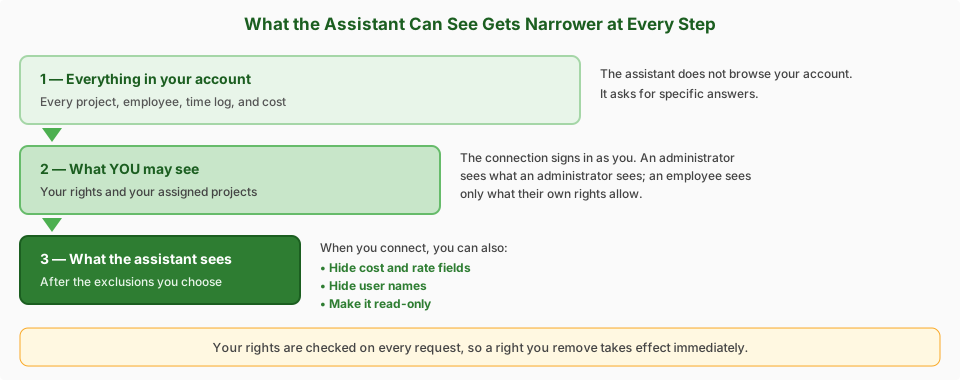
| Layer | What it controls |
|---|---|
| 1. Your own rights | The connection is you. If you may not view salary rates, or only see the projects you are assigned to, neither can the assistant. Rights are checked on every request, so removing a right takes effect at once. |
| 2. Exclusions you choose | Chosen when you connect (or when an administrator issues a key). They hide cost and rate fields, hide user names, make the connection read-only, or turn off creating and copying records. See the list below. |
| 3. Project-level opt-out | A project whose AI-updates setting is turned off cannot be changed by the assistant, whatever the connection allows. |
| 4. Your approval | Every change needs a preview and your approval. In Manual mode, Claude also asks before it applies. |
| 5. Disconnecting | You can revoke the connection at any moment, and it loses access immediately. |
The exclusions
| Exclusion | Effect |
|---|---|
| Cost and rate fields | Client and salary costs and rates are withheld, even from a user whose rights allow them. This is the default for a new key. |
| User names | The assistant sees stand-ins such as “User 1” instead of real names. |
| Database writes (Read only) | No changes of any kind. The assistant is never offered the tools that change data. |
| Database record creation | The assistant may edit existing tasks, but not create or copy tasks and projects. Excluding writes also excludes creation. |
Connect Claude Code or Cursor With a Key
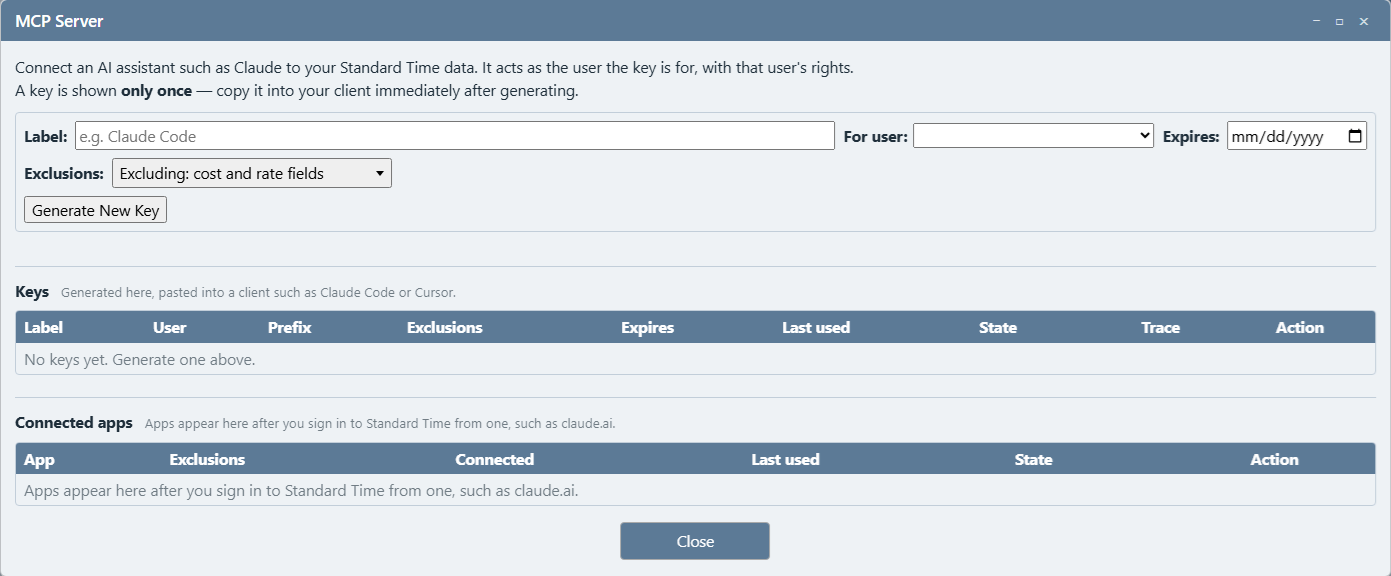
Claude on the web signs in with your Standard Time® login. Tools that run on your own computer, such as Claude Code and Cursor, can instead send a key — a long secret code that stands in for you. An administrator creates keys in the same MCP Server dialog.
- Open Tools › Integration › MCP Server.
- Type a Label that says what the key is for, such as Claude Code.
- Choose For user. Administrators can create a key for themselves. An administrator who can see all items can also create a key for another eligible person.
- Optionally set an Expires date, so the key stops working on its own. (Point at the field to see the default and longest lifetime.)
- Choose the Exclusions.
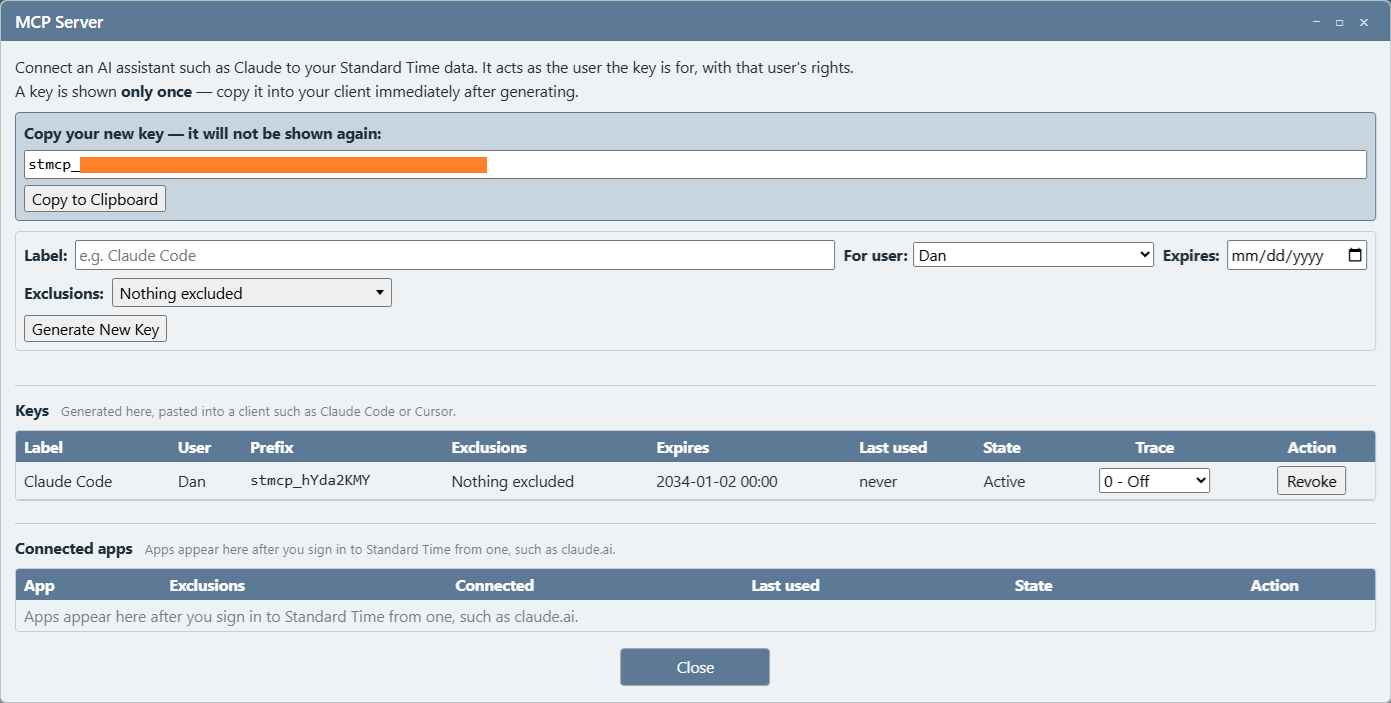
- Click Generate New Key, then click Copy to Clipboard right away.
Give the key to your tool
Add your Connector URL to the tool, and send the key as a bearer token in the Authorization header. In Claude Code, for example, run this in a terminal (replace the address and key with your own):
claude mcp add --transport http standard-time https://YOUR-CONNECTOR-URL \
  --header "Authorization: Bearer YOUR-KEY"
In Cursor, add a remote MCP server with the same address and header; see Cursor's own documentation for the exact screen. Commands and menus change between versions, so check the tool's documentation if a step looks different.
Managing keys
| Column | What it tells you |
|---|---|
| Label, User | What the key is for, and whose rights it uses. |
| Prefix | The first characters of the key, so you can recognize it without revealing it. |
| Exclusions, Expires | What is hidden or disabled, and when the key stops working. |
| Last used, State | When it was last used, and whether it is Active or Revoked. |
| Trace | How much activity is recorded in the activity log: off, errors only, warnings and errors, or everything. Only an administrator can change it. Applying and undoing a change are always recorded, and records are kept for 30 days. |
| Action (Revoke) | Cuts off the key at once. Everyone can see and revoke the keys that act as them. An administrator who can see all items can revoke any key. |
Each key is limited to 120 requests per minute, which is far more than a person typing questions will ever use.
Disconnect or Revoke Access
You can cut off Claude at any time from the same dialog: Tools › Integration › MCP Server. Under Connected apps, find the connection and click Revoke. (For a key, use Revoke in the Keys list.)
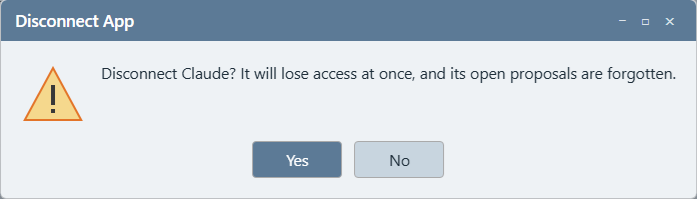
A revoked connection stays in the list, dimmed, with the state Revoked, so you have a record of it. To connect again, repeat the setup steps — you will get a fresh consent page, which is also your chance to choose different exclusions.
You can also remove the connector inside Claude from the Plugins page. Revoking in Standard Time® is the one that actually shuts the door, because it ends the connection on our side immediately.
Tips and Troubleshooting
| What you see | Likely cause and fix |
|---|---|
| Claude says it cannot find Standard Time or has no tools for it | The connector is switched off for this chat. Click + › Plugins and turn on Standard Time. |
| The sign-in page says the username or password is incorrect | Check both. Several wrong tries in a row lock sign-in for a while, so wait before trying again. |
| Sign-in is refused even with the right password | The account may lack the Access to AI right, or may not be an administrator (a requirement by default). Ask an administrator. |
| “That proposal is no longer available. Propose the change again.” | The proposal expired (30 minutes), you were disconnected, or the connection sat idle for a long time. Ask Claude to propose the change again and review the new preview. |
| Claude cannot answer a cost or rate question | Cost and rate fields are hidden on this connection (or your own rights do not allow them). To change the connection, revoke it and connect again without that exclusion. |
| Claude shows “User 1” and “User 2” instead of names | User names are hidden on this connection. Reconnect without that exclusion if you want real names. |
| Claude asks you to sign in again | The connection went unused for about 30 days, or it reached its roughly six-month limit. Sign in again from the connector page. |
| Claude stops and asks permission on every lookup | You are in Manual mode with read-only tools set to Needs approval. Set them to allow in the connector's Permissions tab. |
| Claude skipped some rows | The project's AI-updates setting is turned off, or your rights do not allow that change. Claude lists what it skipped and why. |
| Claude is slow or reports a rate limit | A single key is limited to 120 requests per minute. Wait a moment and try again. |
| A key stopped working | It may have expired or been revoked, or its user may have been deactivated or lost the Access to AI right. Check the Keys list, then issue a new key if needed. |
Safety Built In (and Limits)
What protects you
- It acts as you, with your rights. There is no separate permission system and no way to see more than you can.
- Rights are re-checked on every request. Remove a right, deactivate a user, or revoke a connection, and it takes effect on the very next request.
- Changes are two steps. A preview, then an apply that you approve. Even if text inside your own data (such as a task note) contained instructions, nothing is changed without that approved apply step.
- Everything travels over HTTPS. Keys are stored scrambled, never in readable form, and are shown to you only once.
- Sign-in is rate-limited. Repeated wrong passwords lock sign-in for a while, and all failed attempts look alike, so nobody can use them to guess which user names exist.
- There is a record. Applying and undoing changes are always logged, and an administrator can turn on more detailed activity logging for a key.
Limits to know about
- The assistant can edit and create tasks and projects only. Time logs, expenses, invoices, and existing project settings are read-only to it.
- It never deletes or merges anything, so removing records is always done in Standard Time® itself.
- Sign-in is set up for Claude (claude.ai, Claude Desktop and mobile) and for tools that run on your own computer, such as Claude Code and Cursor. Other assistants may not be able to connect yet.
- It is available for Standard Time® cloud accounts only.
- An AI assistant can misunderstand a request or make a mistake. That is why every change shows a preview first — read it before you approve.
- Claude is a separate service from Anthropic with its own account, plans, and menus. Those can change; the Standard Time® side described here stays the same.
- How to Use AI Chat — the AI assistant that lives inside Standard Time®
- AI Providers Integration — connect Standard Time® to an AI model with your own key
- OData & Power BI — dashboards and reporting across thousands of records
- Zapier — event-driven automation between Standard Time® and other apps
- Webhooks — a real-time event feed to your own systems
- API Connections — let a script ask another system for a go / no-go answer during a scan
- Gantt Chart & Project Tasks — the tasks the assistant can read and change
- How to Set Up Users — rights, administrators, and who can see what
- Integrations
- FAQ: Integrations & Data