23 April 2026
Manufacturing Returning to America
For the first time in a generation, the math is changing. Domestic factories are going up faster than at any point in modern U.S. history, and the companies building them are not doing it out of sentiment — they are doing it because the economics finally make sense. Here is what is driving the rebound, what it means for existing manufacturers, and what shops need to prepare for the surge in domestic demand.
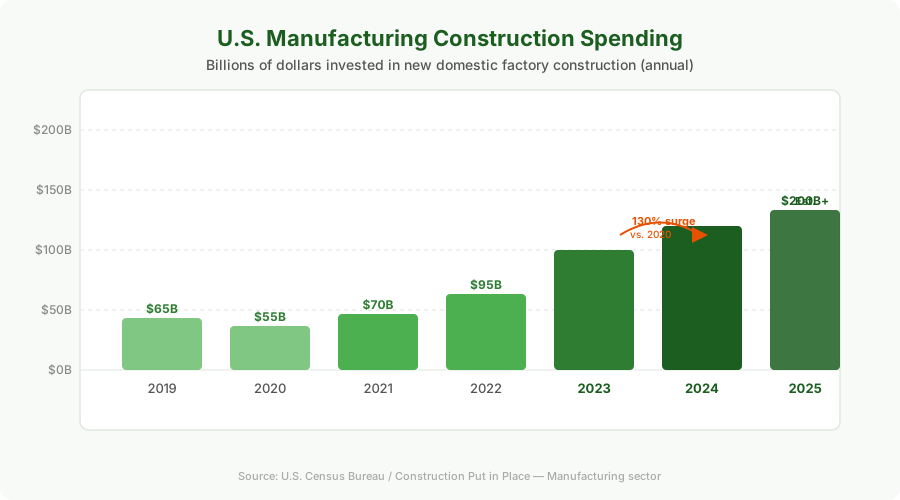
Annual U.S. manufacturing construction spending has more than tripled since 2020 — the steepest sustained rise in modern industrial history.
Nevada News & Views — a detailed look at the investment figures, the industries leading the charge, and the policy landscape driving the shift.
The Numbers Are Striking
U.S. manufacturing construction spending has surged by more than 130 percent since 2020, hitting levels not seen in any prior decade. The industries leading the charge span the full breadth of American production:
- Semiconductor fabrication — new fabs in Arizona, Ohio, and Texas backed by hundreds of billions in public and private investment under the CHIPS Act
- Electric vehicle assembly — battery gigafactories and final-assembly plants spread across Michigan, Georgia, Tennessee, and Kentucky
- Defense and aerospace — expanded production lines responding to procurement demand both domestically and from allied nations
- General manufacturing — smaller shops and mid-size contract manufacturers picking up work that previously went offshore
These are not projections or optimistic forecasts. They reflect actual construction-permit data, Census Bureau put-in-place figures, and publicly announced plant announcements tracked by the Reshoring Initiative and others. The trend is real, broad-based, and accelerating.
What Changed — and Why Now
Several forces converged in a short window to flip the calculus on domestic manufacturing. None of them is temporary.
Supply chain fragility exposed by COVID. The pandemic shut down ports, stopped container ships, and left assembly lines idle for want of a single component sourced from a single factory in a single country. For every C-suite that had optimized for lowest unit cost, 2020 and 2021 were a crash course in the hidden cost of single-source, single-geography supply chains. Resilience became a board-level priority almost overnight.
Tariffs and trade policy. The tariff regimes that took shape over the past several years — expanded under multiple administrations — fundamentally changed the landed cost of imported goods. When the price gap between a domestic part and an imported one narrows to single digits, the calculus shifts. Add in the inventory carrying costs, long lead times, and logistics uncertainty of overseas sourcing, and domestic production starts to look like the lower-risk option even before the tariff math is complete.
Government incentives at an unprecedented scale. The CHIPS and Science Act directed tens of billions toward semiconductor manufacturing specifically. The Inflation Reduction Act offered production tax credits for clean energy components. Infrastructure spending created downstream demand for domestically sourced steel, concrete, and engineered components. These were not grants handed to legacy industries to preserve jobs — they were structured incentives designed to attract new facilities and new production at scale.
Automation closing the labor cost gap. Overseas manufacturing held a significant labor cost advantage for decades. That advantage has eroded as wages in manufacturing hubs in Asia have risen, as shipping costs have spiked, and as automation technology has made it possible to run high-output production lines in the U.S. with fewer direct labor hours. Robotics, vision systems, CNC automation, and AI-driven scheduling have all made domestic factories more competitive on a fully-loaded cost basis.
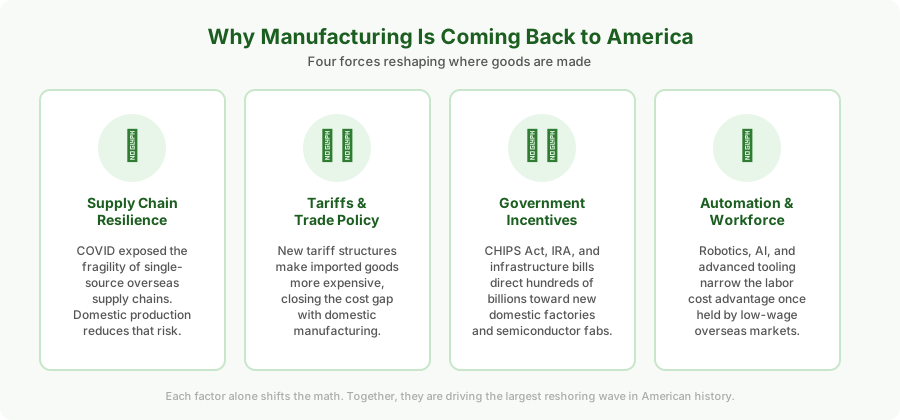
Four reinforcing forces — not one silver bullet — are combining to make domestic manufacturing the logical choice again for a growing range of industries.
Our Take: This Is Not a Cycle — It Is a Structural Shift
Manufacturing has experienced cyclical rebounds before. Orders pick up, capacity utilization ticks higher, a few plants reopen, and then the next downturn reverses the gains. This rebound looks different in kind, not just degree.
The investment is going into permanent fixed assets — fabrication plants, foundries, assembly facilities — that take years to plan, permit, and build, and that are not going to be mothballed when the next quarter comes in light. A semiconductor fab does not get dismantled because imports briefly get cheaper. A battery plant does not relocate offshore because freight rates dip for six months.
What is more significant is that the rebound is policy-locked in ways that prior recoveries were not. The CHIPS Act funding comes with location requirements and domestic content strings attached. Defense procurement increasingly mandates U.S.-sourced components. These mechanisms create a floor under domestic production that pure market forces alone would not sustain through a downturn.
The honest caveat is that the new facilities will need workers, and the skilled workforce pipeline is not yet keeping pace with announced capacity. Welders, machinists, CNC operators, quality technicians — demand is outrunning supply in virtually every metro area where major manufacturing announcements have landed. That workforce gap is the single biggest risk to the pace of the buildout, and it is something every shop manager needs to plan around now.
What This Means for Existing Manufacturers
If you are already running a domestic shop, the rebound is an opportunity — but only if you can handle the volume. The shops that are going to win new contracts over the next several years are those that can demonstrate capacity, responsiveness, and cost visibility. A manufacturer that cannot tell a new customer when a work order will be complete, what the labor cost will be, or how many hours a given task will take is at a structural disadvantage against one that can answer all three questions before the purchase order is signed.
This is not a theoretical concern. Procurement teams at major primes and OEMs are actively qualifying domestic suppliers right now. The questions they ask during supplier audits have changed. They are not just asking about quality certifications and insurance. They are asking about production scheduling systems, labor tracking, work order management, and data visibility. A shop that runs on paper timesheets and whiteboard schedules will lose those audits to a shop that can hand over a digital production record.
The rebound creates urgency around operational readiness that did not exist five years ago. Volume is coming. The shops that are ready to receive it will grow. The ones that are not will watch the work go to competitors who were.
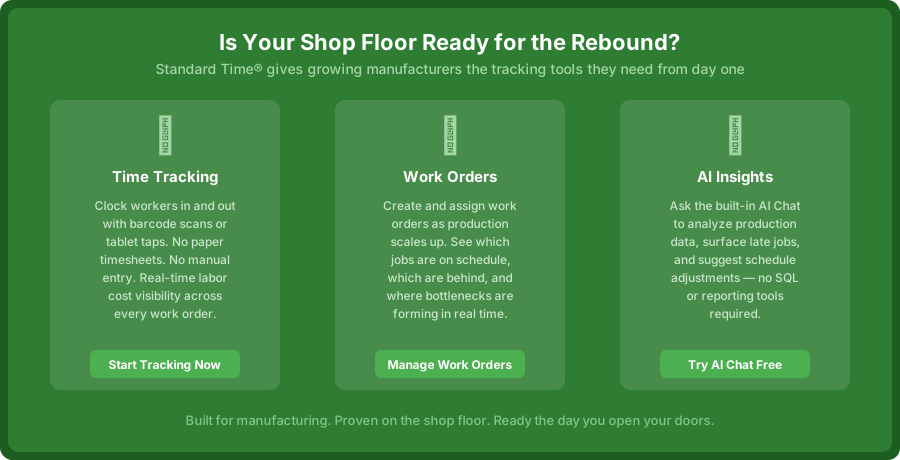
Standard Time® gives growing manufacturers the visibility they need to take on new volume without losing control of cost, schedule, or quality.
How Standard Time® Helps Shops Scale with the Rebound
Standard Time® is built for exactly this moment. It gives shop floor managers the tools to handle more work orders, more workers, and more complexity — without adding administrative overhead or hiring additional office staff to keep up with reporting.
- Barcode-driven time tracking — Workers clock in and out of jobs with a single scan. No paper timesheets, no manual entry, no end-of-week scramble to reconstruct who worked on what. Labor cost is captured in real time against every work order.
- Work order management — Create, assign, schedule, and close work orders from a central dashboard. See at a glance which jobs are on track, which are behind, and where labor hours are being consumed. When a customer asks for an update, the answer is a click away.
- AI-powered project analysis — The built-in AI Chat window can analyze production data across all active work orders, surface at-risk jobs, and suggest schedule adjustments. No SQL, no custom reports — just a conversation with your production data.
- Scalable from one station to many — Start with a single barcode scanner and a tablet. Add scanning stations as you add workers and shifts. The system scales with your headcount without requiring new infrastructure or retraining.
The shops winning new business in the domestic manufacturing rebound are the ones that can prove they can handle it. Standard Time® is how you make that proof visible — to customers, to procurement teams, and to yourself.